YouTube
Economy
Profit: the fare is only half the decision
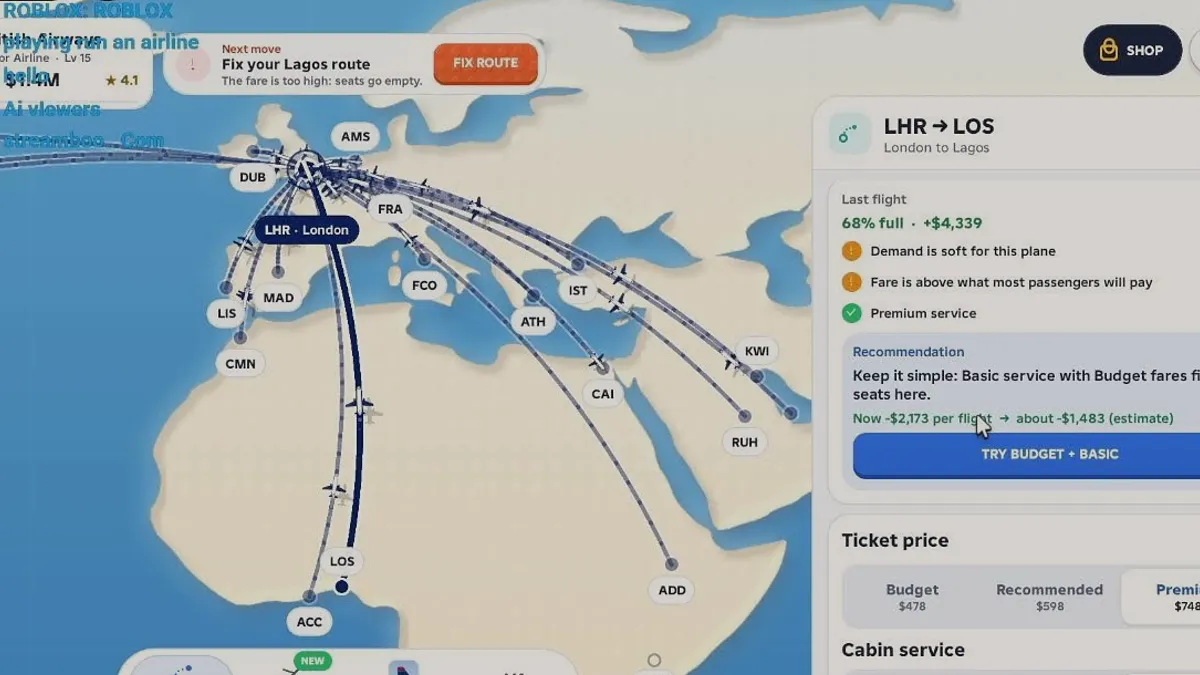
A flight's result depends on the fare tier, the cabin service price and how full the cabin was. On the reviewed London–Lagos card the game showed 68% full and +$4,339 on the last flight, while still warning that the fare was too high for the route.
Per flightFare × seats × load
ReserveCash you never spend
Passes2X cash and +50% speed
Watch and verify
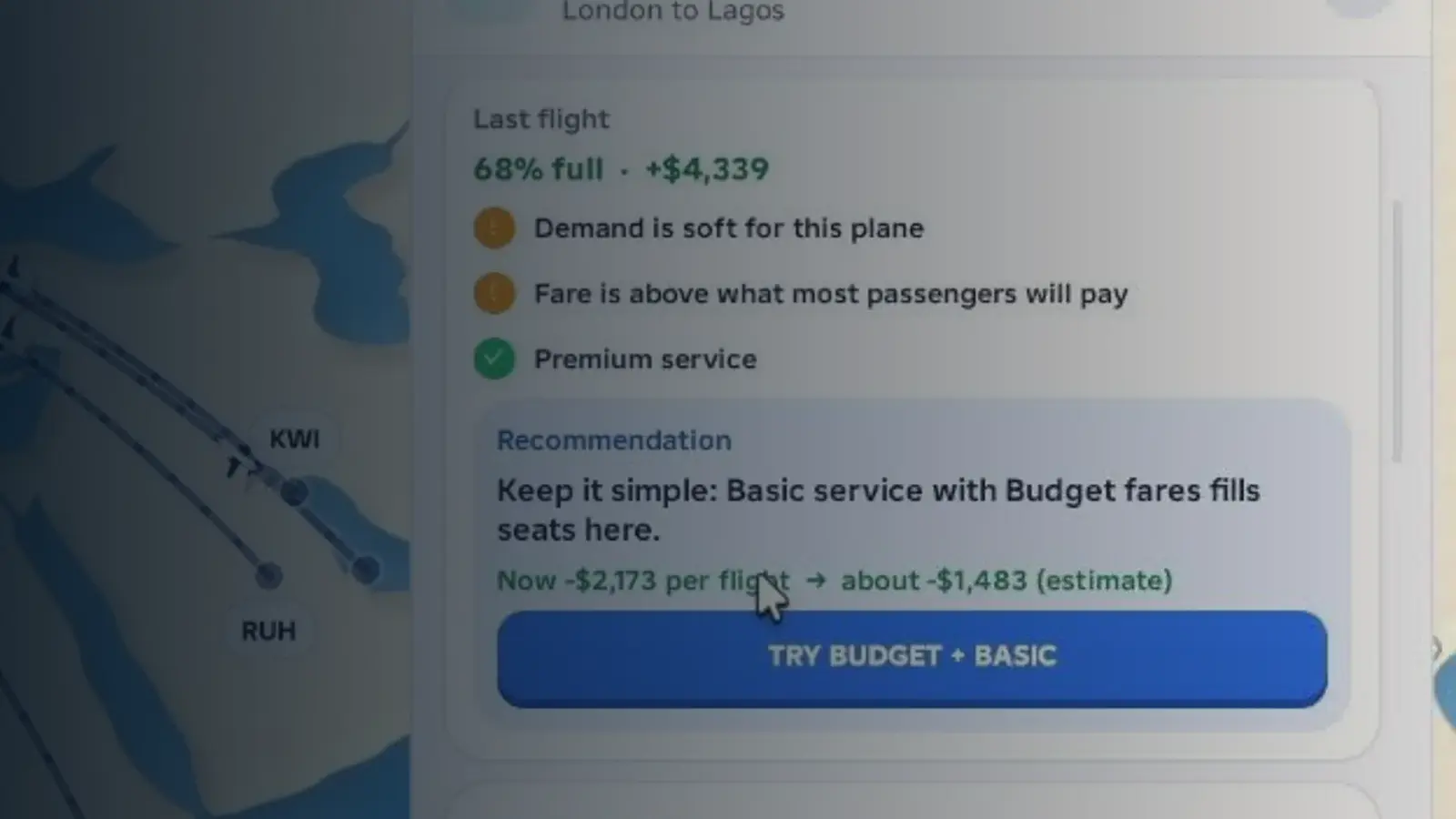
Watch a loss-making route get a recommendation
The recording pauses on a route losing $2,173 per flight and shows the game's own estimate of -$1,483 after switching to budget fares and basic service.
What this section measures
The game reports cash per flight, not cash per hour. That is fine for a single route and misleading once you own several aircraft, because a long sector occupies the aircraft for longer.
This section converts the card's numbers into the three figures that actually drive decisions: profit per flight, profit per aircraft-hour and the break-even load factor. All three use values you can read in game, so nothing depends on an unpublished formula.
Sources and references
- Run an airline — official Roblox experience page
Supports the game identity, creator, release date, server size, genre and the published feature list quoted on this site.
Accessed - Roblox Games API — universe 10768550253
Supports visit count, favourites, active players, maximum server size, genre tags and the created/updated timestamps used in the snapshot table.
Accessed - Roblox votes API — universe 10768550253
Supports the 1,432 up / 208 down vote counts behind the 87.3% approval figure. Approval is computed, not published by Roblox.
Accessed - Roblox game passes API — universe 10768550253
Supports the six pass names and the effect wording quoted in the monetisation pages. It does not publish prices.
Accessed - Creator profile — monkeytherobloxdev
Confirms the creator account behind the experience. The profile itself carries no studio or support page.
Accessed - ROBLOX playing run an airline — Krakenking17
Public live recording used for the LHR → LOS route card: fare tiers $478/$598/$748, 68% load, +$4,339 last flight, -$2,173 to -$1,483 recommendation, and cabin service at $3/$9/$20 per seat.
Accessed
Official pages
The store lists the cash and speed passes; the experience page lists the loop.
Choose a money question
Profit, reserve or pass value.
Featured money guides
Profit, reserve, then the passes.
All money guides
Every published page in the money section.
Profit
Run an Airline Profit: How to Read a Flight's Result
A flight's profit is the fare revenue from the passengers who actually boarded, minus the per-seat service cost and the aircraft's operating cost. The route card gives you the inputs; dividing the result by block time gives you the number that compares routes.
Reviewed 2026-10-18Cash flow
Run an Airline Cash Flow: How Big a Reserve to Keep
Keep enough cash to run your worst route twice at a loss before you buy anything. A reserve turns a bad fare experiment into information; no reserve turns it into a stalled airline that cannot afford the fix.
Reviewed 2026-10-18Pass economics
2X Cash and +50% Flight Speed: What They Actually Change
2X Cash doubles the cash from profitable flights only, so it does nothing for a losing route. +50% Flight Speed makes flights finish 33% sooner, which raises cycles per session by 1.5× rather than doubling them.
Reviewed 2026-10-18Pairs well with
Money questions
How does the game calculate cash from a flight?
The formula is not published. The card shows the fare tier, the cabin service price per seat, the load factor and the resulting per-flight figure, so the visible inputs can be reconstructed but the exact weighting cannot.
What does 2X Cash actually double?
The store description says it doubles cash from every profitable flight. A flight that loses money stays a loss, so the pass rewards routes that already clear zero rather than rescuing negative ones.
Does +50% Flight Speed mean twice as many flights?
No. The store states that flights finish 33% sooner. A three-hour sector becomes about two hours, which raises cycles per session by 1.5× for that sector, not by 2×.
Should I spend cash on a new route or a new aircraft?
Add a route first when an existing aircraft has spare hours and the destination is inside its range. Buy an aircraft first when every route is already covered and the cash gap is small enough to keep a reserve.
Run the numbers on your own route
The calculator accepts the values printed on your route card and returns margin, break-even load and profit per hour.